

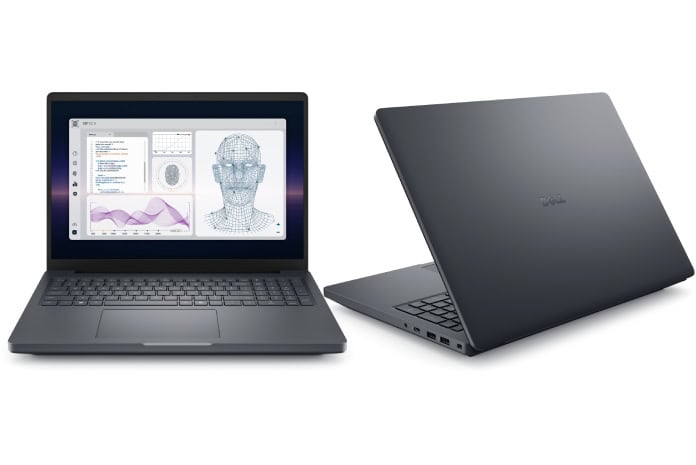
Dell has unveiled the Pro Max 16 Plus, a mobile workstation built to deliver datacentre-class AI inferencing directly on-device — eliminating dependence on the cloud for processing speed, privacy and cost efficiency. The device is the first mobile workstation to feature an enterprise-grade discrete NPU, powered by the Qualcomm AI 100 PC Inference Card, bringing high-fidelity FP16 performance traditionally found in server environments to a portable form factor.
The Pro Max 16 Plus is designed for professionals who rely on AI in time-critical and data-sensitive sectors — including healthcare, finance, government, engineering and field research. By running AI models locally rather than offloading workloads to the cloud, the device addresses growing demands for low latency, airtight data privacy, predictable costs and operational agility.
At the core of the workstation is a dual-NPU architecture, featuring two AI-100 NPUs on a single card with 64 GB of dedicated AI memory engineered for sustained inferencing. According to Dell, this enables the notebook to run large-scale AI models with up to approximately 120 billion parameters while maintaining full FP16 accuracy — a leap that allows complex workloads to execute in real time.
Tackling latency, privacy and mobility
The move toward localised inferencing marks a shift from traditional cloud-centric AI models. The Pro Max 16 Plus delivers real-time insights without cloud round-trips, enabling workflows even in disconnected or air-gapped locations. This capability is particularly relevant in regulated environments where data sovereignty is mandatory.
Dell highlights three primary benefits of the on-device AI architecture:
- Zero cloud dependency and latency, ensuring time-critical insights without performance drops
- Security by design, keeping all data and inferencing on-device for compliance and confidentiality
- Predictable investment, eliminating recurring cloud inferencing fees and usage-based pricing models
The workstation also introduces a new dimension of mobility. Dell describes it as effectively becoming an “edge server you can carry” — bringing high-powered AI capabilities to clinics, factories, labs, corporate war rooms or field deployments.
Real-world use cases across industries
The Pro Max 16 Plus is positioned for diverse workloads:
- Healthcare: Medical images such as MRI and CT scans can be processed locally for rapid diagnostics without transmitting patient data externally.
- Finance, legal and government: Predictive models, fraud detection, document classification and deposition transcription can run securely in air-gapped environments.
- Engineering and research: Developers can validate and benchmark models locally without reliance on cloud queues, while robotics and computer vision teams can process live sensor data in real time.
NPU built for inferencing — not a replacement for GPUs
While GPUs continue to play a crucial role in simulation, graphics and AI training, Dell emphasises that the discrete NPU is optimised specifically for sustained inferencing. Compared to integrated NPUs in standard laptops — which are typically limited to OS-level enhancements and small model execution — the AI 100 PC Inference Card is designed for full-scale production workloads with 32 AI cores and 64 GB of dedicated memory.
Flexibility for enterprise environments
The workstation supports both Windows and Linux, allowing developers to work within their preferred toolchains. In Windows environments, the device integrates with Dell’s AI PC ecosystem for streamlined lifecycle management and security policy control.
A shift toward local AI computing
With enterprises increasingly seeking faster decision-making and greater control over sensitive data, the Pro Max 16 Plus signals a shift toward cloud-optional AI architectures. Dell positions the workstation as the next evolution of professional computing — where AI performance, privacy and mobility converge in a single machine.
The company says the device is intended for professionals who cannot afford delays or compromise. As organisations accelerate AI adoption across industries, the launch of the Pro Max 16 Plus suggests that the future of AI is not only more advanced — but also more local, more secure and more portable.





thanks for this